What to Expect on the Base Torres Trail: A Realistic Difficulty Guide
By Southwind Experience — Local Travel Specialists based in El Calafate, Patagonia

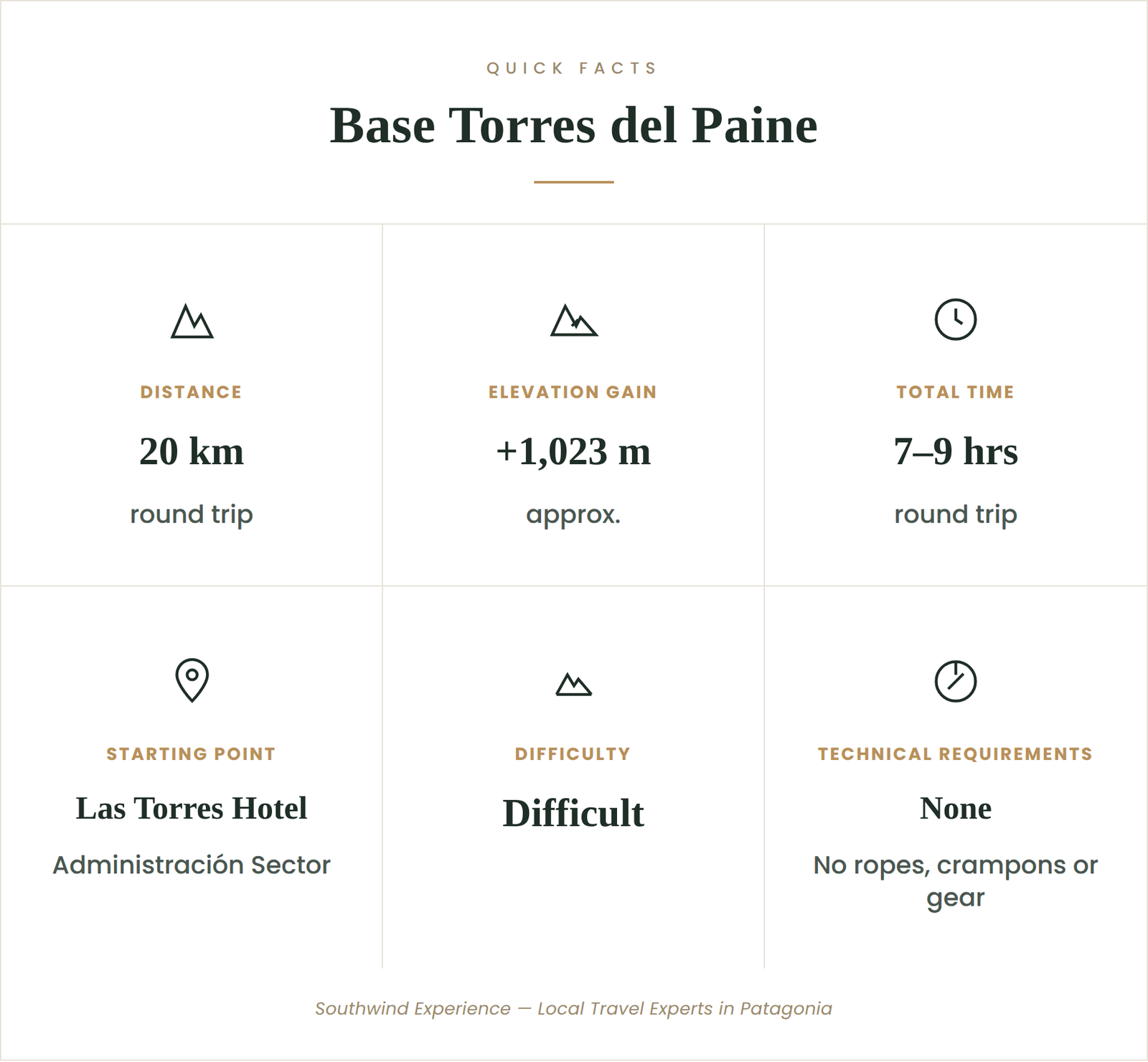
The Base Torres trail is not technically difficult, but it is long, and the final section will surprise you. Most people complete it in 7 to 9 hours round trip. The trail is well-marked and requires no mountaineering experience. What catches travelers off guard is the 45-minute boulder scramble at the very end — after six hours of hiking — and the fact that the towers themselves are invisible until you crest that final moraine. Everything below that point is beautiful, but the iconic view only appears in the last ten minutes. Here is what the trail actually looks like, section by section.
The Trail in Numbers
Section by Section: What You're Actually Walking

Section 1 — Las Torres Hotel to Refugio Chileno (4 km, ~1.5 hours): The trail begins at Las Torres Hotel in the Administración sector of Torres del Paine and descends briefly before crossing the Río Ascensio on a footbridge. From there it enters lenga beech forest and climbs gradually alongside the river. This first section is the most forgiving of the day. The path is wide, well-maintained, and sheltered from the wind. It's where most people set their hiking pace — which is often too fast for what comes later. Refugio Chileno appears at the 4 km mark, approximately 90 minutes from the start. It serves food and has toilet facilities. This is the last place to refuel and rest before the more demanding upper section.

Section 2 — Refugio Chileno to the Mirador Base (4–5 km, ~2 hours): Above Chileno the trail leaves the forest and enters open terrain. The valley widens, the wind becomes more present, and the scale of the massif above begins to register. This middle section climbs steadily but not steeply. The path crosses a small bridge over a secondary stream, moves through low shrubs and exposed rock, and gains elevation at a pace that most hikers find manageable. What changes here is the exposure — there is no longer forest to break the wind, and the views back down the valley open considerably. On clear days, the upper portion of the Torres becomes visible to the north, still more than an hour away. On overcast days, the towers disappear into cloud from this point until the very top — which happens often enough that it's worth knowing before you start.

Section 3 — The Final Ascent (approximately 1 km, 45–75 minutes): This is the section that earns the trail its "challenging" rating. The path transitions from maintained trail to a steep scramble over large boulders and loose scree. There is no cable, no railing, and no single obvious line — the route is marked by cairns, and progress is measured in careful foot placements rather than steps. The elevation gain in this section is approximately 200 meters over roughly one kilometer. On fresh legs, that would take 30 minutes. At the end of a 6-hour hiking day, it takes most people 45 to 75 minutes.
A few things make this section harder than it reads on paper: Wind: the moraine acts as a funnel for Patagonian gusts. Wind speeds at the top regularly exceed what was felt anywhere on the lower trail. Fatigue: six hours in before the crux. Knees that felt fine at Refugio Chileno are already working differently by this point. Cold: the temperature at the lagoon is significantly lower than in the valley below. Layers that felt unnecessary at 11 AM become necessary at 2 PM. The boulder field ends abruptly at the moraine crest, where the three granite towers — Torre Sur, Torre Central, and Torre Norte — appear directly above a milky glacial lagoon. The view is immediate and total. Most people stop moving for several minutes.
What the Trail Looks Like on Different Days

Clear and Calm: The best-case scenario: the towers reflect partially in the lagoon, the light on the granite changes throughout the morning, and the wind at the top is manageable. Arrive at the lagoon by 11 AM for the best light and the fewest other hikers. By 1–2 PM, groups from later starts fill the viewpoint.
Overcast but Stable: The towers disappear in cloud from Refugio Chileno onward, but the trail remains enjoyable. The lagoon itself is impressive regardless of whether the towers are visible — the color of the water, the scale of the moraine, and the sound of the wind across the glacial bowl are worth the effort even without the full granite spectacle. Many hikers who arrive in cloud see the towers emerge briefly as weather shifts through the morning.
High Wind and Deteriorating: The upper boulder section becomes genuinely difficult and potentially unsafe above 60–70 km/h. Local guides monitor the forecast carefully and make the call at Refugio Chileno — turning back at that point is not a failure, it is the correct decision. A separate day or an adjusted schedule within Torres del Paine is always the better option.
Start Times and Crowd Management

Departure from Las Torres Hotel: 7:00–7:30 AM
This is not a preference — it is the operational standard for guides working the trail. Starting at this time means:
Reaching the lagoon between 10:30 and 11:30 AM, when the light is best
Completing the boulder descent before the afternoon wind peaks
Returning to the hotel by 3:00–4:00 PM, before the last transfer window
Groups that start at 9:00–10:00 AM arrive at the lagoon in early afternoon, complete the descent in the highest wind conditions of the day, and frequently return after dark in shoulder season. It is not dangerous, but it is significantly less pleasant.
The Descent: What People Don't Talk About

Most trail descriptions focus on the ascent. The descent deserves equal attention. The boulder section going down is harder on the body than the way up — technically more demanding for knees and ankles, and requiring more concentration per step. Allow 45–60 minutes for this section on the way back, the same as the ascent. The section from Refugio Chileno back to the hotel is where fatigue accumulates. The lenga beech forest is beautiful, but after 7+ hours of hiking the final 4 km feel longer than they did in the morning. Trekking poles make a meaningful difference here. Total descent time from the lagoon to the hotel: 3 to 4 hours.
What to Bring

Non-negotiable:
Wind and waterproof outer layers (pack, don't leave at the hotel)
Warm mid-layer for the lagoon
Trekking poles — particularly important for the boulder descent
2.5 to 3 liters of water
High-energy snacks for the full day
Frequently underestimated:
Sunscreen — UV exposure above the forest line is significant even on overcast days
Gloves — the lagoon temperature is 10–15°C lower than the valley floor
Leave behind:
Heavy camera tripods — the wind at the top makes them difficult to use and the added weight on the boulder section is considerable
Frequently Asked Questions
Do I need a guide for the Base Torres trail? The trail is well-marked and can be walked independently. A private guide adds value primarily in two situations: if weather decisions need to be made in real time (a guide knows when to push through cloud and when to turn back), and for travelers who want context about the geology and ecology of the massif as they walk.
Can I do Base Torres and another trail on the same day? Technically yes for fit hikers. In practice, adding Mirador Las Torres (a shorter alternative viewpoint on the same route) or the first section of the French Valley makes for a very long day. We don't recommend pairing Base Torres with a separate full trail.
Is the Base Torres trail the same as the W Trek? Base Torres is one of the three main sections of the W Trek. It can be done as a standalone day hike from Las Torres Hotel without completing the full W circuit.
The Bottom Line

The Base Torres trail is achievable for most travelers in reasonable fitness. The difficulty is not technical — it is cumulative. Eight hours of hiking with a demanding final section at altitude, exposed to Patagonian wind, at the end of a long travel day or a multi-day circuit. Start early, carry layers, and don't underestimate the boulder section going down. The view at the top justifies every meter of it.
Southwind Experience designs private Patagonia itineraries from our base in El Calafate. If Torres del Paine is part of your circuit, we can help you plan the trail sequence, secure lodge accommodation inside the park, and coordinate the cross-border logistics between Argentina and Chile.
Explore our Torres del Paine itineraries →