How Many Days in El Chaltén Is Enough? A Trail-by-Trail Breakdown
By Southwind Experience — Local Travel Specialists based in El Calafate, Patagonia

Three days is the right answer for most travelers. Two days gives you the two main trails — Laguna de los Tres and Laguna Torre — but no buffer if the weather doesn't cooperate on either morning. Three days adds that buffer and opens a third trail that most itineraries skip. Four days is for trekkers who want to leave the valley with nothing unfinished. The rest depends on which trails you actually want to do, what the weather does with you, and how El Chaltén fits within a longer Patagonia circuit. Here is the breakdown, trail by trail.
Five Trails Worth Planning Around
1. Laguna de los Tres — The Essential Fitz Roy Trail
22 km round trip | 960m elevation gain | 8–9 hours | Moderate-Challenging

This is the trail most people picture when they think of El Chaltén — the one that ends with Fitz Roy's north face reflected in a glacial lagoon at 3,054 meters. It deserves its reputation, and it deserves a full day. The first 10 kilometers to the Río Blanco climbers' base camp are gradual and well-maintained, moving through lenga beech forest along the river. That section takes about three hours and is manageable even in overcast conditions.
The final kilometer and a half changes character completely: a steep ascent over loose stone that gains 400 meters and takes between 45 minutes and an hour and a half depending on fitness and wind. This section is exposed. When the wind picks up — and in El Chaltén it picks up with very little warning — the last stretch can be genuinely demanding. On the right morning, the lagoon is still and Fitz Roy reflects perfectly. On a difficult one, the wind is strong enough to make standing upright at the viewpoint an effort.
The verdict: This is the non-negotiable trail. If you only have one good weather window in El Chaltén, use it here.
2. Laguna Torre — Cerro Torre and the Floating Icebergs
18 km round trip | 450m elevation gain | 6 hours | Moderate

The Laguna Torre trail follows the Río Fitz Roy canyon west through different terrain — more open in the first section, narrowing into beech forest as it approaches the moraine that overlooks the lagoon. At the top of that moraine, Cerro Torre's granite needle rises above the water, and small icebergs calved from the Grande Glacier float in the milky turquoise below.
This trail sees fewer people than Laguna de los Tres, particularly after 9 AM. The elevation gain is gentler and more evenly distributed, making it a better choice for a second hiking day when legs are already tired from Fitz Roy. The atmosphere at the lagoon is different too — more austere, windier (the Patagonian weather funnels through the canyon from the ice field), and quieter in a way that the Laguna de los Tres viewpoint rarely is.
The verdict: The right trail for a second day. Less dramatic than Laguna de los Tres, but with a quality of silence that many travelers prefer.
3. Loma del Pliegue Tumbado — The 360° View Nobody Prioritizes
21 km round trip | 1,200m elevation gain | 7–9 hours | Challenging
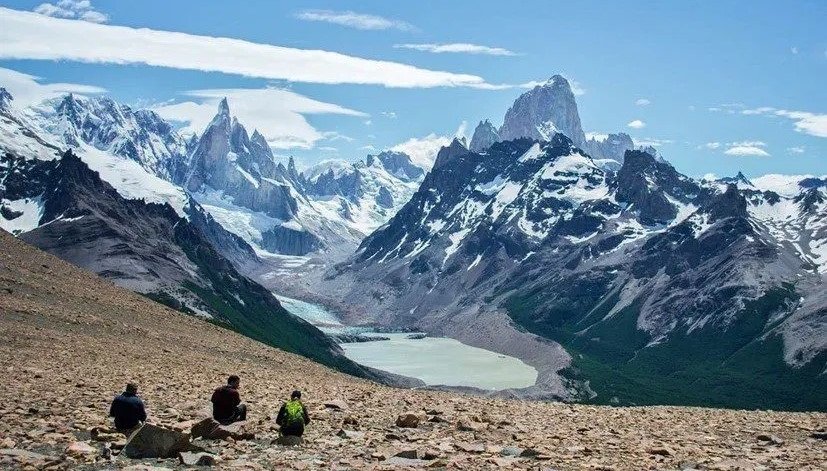
This is the trail most travelers either don't know about or drop from the itinerary when time gets tight. That's a mistake. Loma del Pliegue Tumbado climbs southeast from the trailhead rather than northwest like the other trails, reaching an open plateau with a fundamentally different perspective of the massif — from the side and slightly above, rather than from directly beneath.
At the summit ridge, the panorama extends simultaneously over: Fitz Roy and Cerro Torre to the west, Lago Viedma and the Patagonian steppe to the east and The Southern Patagonian Ice Field to the south on clear days. No other trail in El Chaltén delivers that complete geography in a single viewpoint.
The climb is demanding — the most sustained elevation gain of the three main trails — and the exposed upper section should not be attempted in deteriorating weather. But for travelers who have already done Laguna de los Tres and Laguna Torre and want a third day with a genuinely different visual experience, this is the answer.
The verdict: The most underestimated trail in the park. Worth every meter of the ascent for the complete ice field panorama.
4. Reserva Los Huemules — Laguna del Diablo and Laguna Azul, Away From the Park Crowds
Half-day trails | 5–10 km round trip depending on route | Low–Moderate | Advance booking required

This one requires a separate explanation because it is not a park trail — it is a private nature reserve located about 17 kilometers from El Chaltén, and access requires an advance online reservation through the reserve directly. Estancia Los Huemules is a conservation reserve protecting a valley of native lenga forest and glacial lagoons, and it's the habitat of the huemul, the endangered deer the reserve is named for. Two shorter trails inside it stand out for travelers who want a change of pace from the three main park hikes:
● Laguna Diablo (about 5 km one way, 2.5–3 hours, moderate): follows the north bank of the Río Diablo through a younger, steeper valley, with a couple of pronounced climbs in the first two kilometers. Hikers who want a longer day can push on to Puesto Cagliero, a backcountry refuge facing the lagoon and its glacier.

● Laguna Azul (5 km round trip, about 2 hours, low difficulty): starts near the reserve's visitor center, crosses a footbridge over the Río Diablo, and climbs gently through lenga forest past a small waterfall to a still, crystalline lagoon framed by Cerro 30 Aniversario. Travelers with a bit more time can continue another 500 meters to Laguna Verde, which opens onto a rarely photographed angle of Fitz Roy's north face with Cerro Eléctrico behind it..
Longer options exist too. Los Huemules also runs the Sendero Filo o Loma, the reserve's longest and most demanding route, along with the Sendero Valle del Río Eléctrico and the Mirador Laguna Cóndor trail — worth asking about when booking if a fuller day of walking is the goal.
The verdict: Laguna Azul is an easy half-day for anyone, Laguna Diablo has more character for those wanting a longer walk, and the reserve's longer trails are there for travelers who want to make a full day of it. A perfect option if you have more days in El Chalten or if you prefer shorter trkking options
.
5. Lago del Desierto and the Glaciar Huemul Walk — A Scenic Day North of Town
Half-day to full day | 4 km round trip walk | Low difficulty | Private transfer, boat crossing optional

This one is less a trek and more a scenic detour. Lago del Desierto sits about 37 km north of El Chaltén along the Route 23/41 scenic road, a roughly two-hour drive that is itself one of the more overlooked things to do in the area — it follows the Río de las Vueltas past Laguna del Cóndor, with Fitz Roy and Cerro Torre in view for much of the way, and an optional stop at the Piedra del Fraile shelter if time allows.
At the lake, From Punta Sur, at the southern tip, an easy 4 km round-trip walk (about 2 hours) climbs gradually through lenga forest to a ridge with open views over the Río de las Vueltas valley and Fitz Roy's north face, continuing on to Laguna Huemul, a small lagoon fed by the glacier of the same name. The walk crosses private land, so there's an access fee. Most travelers add a boat crossing — Lago del Desierto stretches north toward the Chilean border, and navigation options let you see it without walking its shoreline.
Worth noting: this easy lakeside walk is a different excursion from the multi-day Vuelta al Huemul circuit, a much longer and more technical trek that requires zipline river crossings and a park permit. The walk described here is the accessible, one-day version reached via Lago del Desierto.
The verdict: Not a trail to prioritize over the four above, but a good lower-effort day for travelers with five or more days in El Chaltén, or a welcome change of pace when legs need a rest from steeper climbs.
.
How Many Days in El Chaltén Is Enough? A Trail-by-Trail Breakdown
The Variable Nobody Plans For: El Chaltén's Weather
No guide to El Chaltén days is complete without an honest discussion of the weather, because it is the single most important variable — more than fitness level, more than trail choice, more than season. El Chaltén sits at the confluence of Andean weather systems from the Pacific and cold air from the Patagonian steppe. In practice, the town can experience four seasons in a single afternoon.
Experienced local guides check wind forecasting models at 6 AM every hiking day. The key variables are southwesterly wind speed and cloud formation over the summits — not conditions in town, which can be clear and calm while the upper section of Laguna de los Tres is in near-whiteout conditions.
What this means for your day count:
2 days in El Chaltén: essentially no weather buffer. If one morning is poor, one trail gets sacrificed.
3 days: changes the equation meaningfully. You wait for the best window for Laguna de los Tres, use a second acceptable day for Laguna Torre, and have a third day for Loma del Pliegue Tumbado or as a genuine buffer.
4 days: you're no longer managing risk — you're choosing experiences.
Day-by-Day Recommendations by Profile
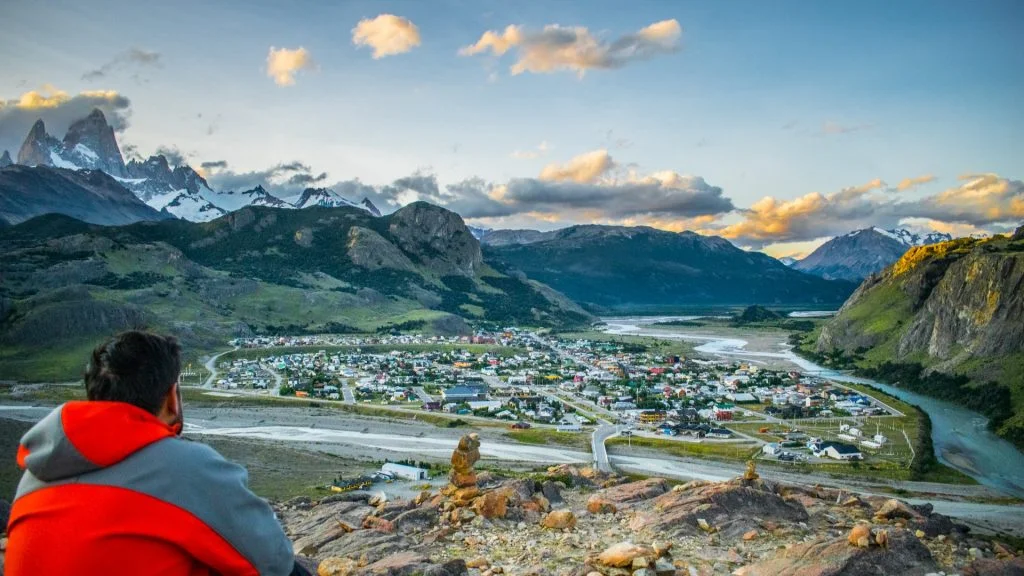
If You Have 2 Days
Day 1: Laguna de los Tres — early start (7:30 AM from town), full day.
Day 2: Laguna Torre — more relaxed start possible, done by 3–4 PM.
Accept that there is no buffer. If day 1 has a poor morning forecast, the most defensible strategy is to reverse the order: Laguna Torre first, then attempt Laguna de los Tres on whatever morning day 2 delivers. Do not leave El Chaltén without attempting Laguna de los Tres at least once — even reaching Río Blanco base camp without making the final ascent is worthwhile.
If You Have 3 Days (The Standard Recommendation)
Day 1: Arrive, rest, walk the Mirador de los Cóndores circuit (2 hours from town). Observe the sky at dawn on day 2.
Day 2: Laguna de los Tres if the forecast is right. If not, Laguna Torre.
Day 3: Whichever of the two you didn't do on day 2, or Loma del Pliegue Tumbado if both main trails are complete and conditions allow.
This structure includes one arrival day that most itineraries underestimate. Travelers who arrive on an overnight transfer from El Calafate after a long international journey and immediately attempt Laguna de los Tres on tired legs consistently report that the day felt harder than it should have.
If You Have 4 Days (The Full Experience)
Day 1: Arrival + Mirador circuit.
Day 2: Laguna de los Tres on first good forecast.
Day 3: Laguna Torre.
Day 4: Loma del Pliegue Tumbado, Estancia Los Huemules or Lago del Desierto.
.
Four days in El Chaltén is not excess. It is the allocation that allows you to experience three genuinely different landscapes — the north face of Fitz Roy, the needle of Cerro Torre, the plateau panorama — without ever feeling that any one of them was rushed.
How El Chaltén Fits in a Broader Patagonia Circuit

A common planning question: if you're combining El Chaltén with El Calafate and Torres del Paine, which destination deserves the most days? El Chaltén is a hiking destination almost exclusively. If walking is the point of your trip, El Chaltén deserves priority. A circuit that gives El Chaltén 3 days, El Calafate 2 days, and Torres del Paine 4 days is a well-balanced 9 to 10-day Patagonia itinerary. Compressing El Chaltén to 2 days saves a day that is almost never worth saving.
The Bottom Line
Two days in El Chaltén gives you the essentials. Three days gives you the flexibility to actually enjoy them. Four days gives you everything, including the trails that most travelers don't know they want until they're standing in the valley wishing they had booked one more night. If your Patagonia circuit can absorb the extra day, it should.
Southwind Experience designs private, tailor-made itineraries across Argentina and Chile from our base in El Calafate. If you're planning a Patagonia circuit that includes El Chaltén, we can help you sequence the days, the trails, and the weather windows into an itinerary that actually works.
Explore our El Chaltén and Los Glaciares itineraries →